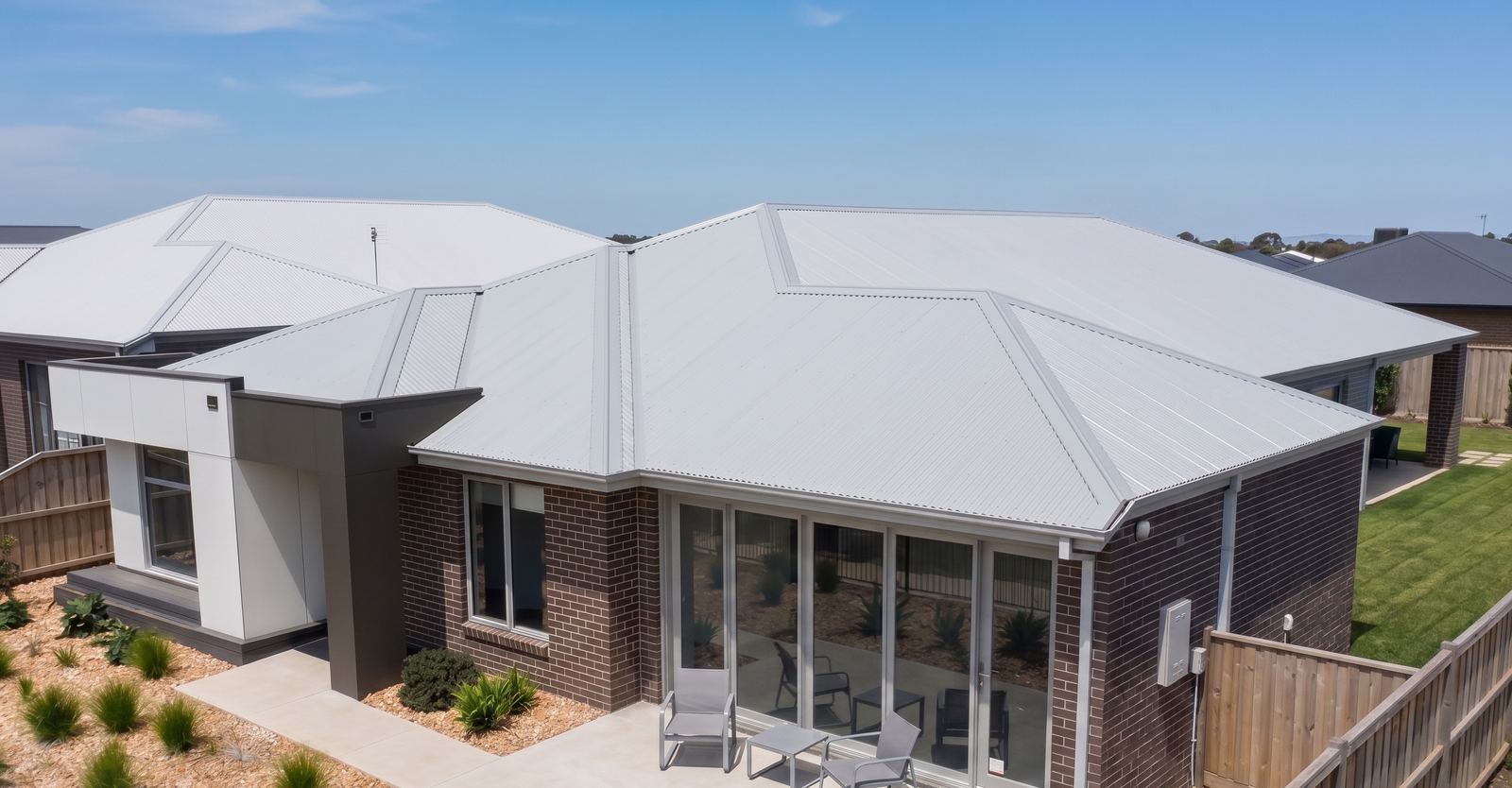
Priced by area
Restoration, painting, cleaning and replacement are all quoted off the square metres of roof. A 120m² villa and a 250m² four-bedroom are different jobs, not different discounts.
Open 24 hours, 7 days — weekends and public holidays included.
Free roof inspection 0434 115 094
Costs and the awkward questions
Every price question we get asked, answered in one place, plus the ones people are too polite to ask until the quote arrives.
Google reviews
Based in Rosehill
Open 24 hours
How roofing is priced
Roofing is priced off things that can only be measured on the roof: the area, the pitch, the material, how many storeys, and how much is broken underneath the growth. Anyone who gives you a firm number down the phone is either padding for the worst case or is planning to find extra work halfway through.
Restoration, painting, cleaning and replacement are all quoted off the square metres of roof. A 120m² villa and a 250m² four-bedroom are different jobs, not different discounts.
Repointing is quoted off the linear metres of ridge and hip capping, which is why a big house with a simple roofline can cost less than a small one cut into six hips.
Our repointing starts at $800
We inspect free, measure it, photograph it, then give you one fixed price that does not move afterwards. If the honest answer is a repair rather than a replacement, that is what the report says.
Free · no obligation
Costs and the awkward questions
Answered here so you do not have to sit through a sales pitch to find out.
Ask us something else · 0434 115 094It is free and there is no catch. We get on the roof, walk it, photograph it and tell you what we found. You get the photos whether or not you use us.
The reason we can do that is simple: a roof we have actually stood on is a roof we can quote accurately, so we are not pricing in guesswork. It is cheaper for us than getting the number wrong.
If the ridge caps are lifting and the mortar is cracked but the tiles and the surface are otherwise sound, you need a re-point, and that starts at $800.
If the tiles have gone porous, the surface is breaking down and there is moss holding water on the roof, you need the full restoration: clean, repair, re-bed, re-point, seal and coat.
The inspection tells you which, in writing, with the photos that show why. We have no interest in selling you the big one when the small one holds.
It depends on things we can only see from the roof: the size and pitch, how many tiles are cracked, whether it is one storey or two, how much moss is holding water, and whether the valleys have gone.
Rather than publish a range that will not match your house, we quote a fixed price after the free inspection, and that price is what you pay. Ridge re-pointing on its own starts at $800.
Call us. The phone is answered around the clock, including weekends and at night, which is exactly when roofs tend to announce themselves.
For an active leak the first job is making it safe and dry, not writing a quote. We tarp it, stop the water, and work out the permanent fix in daylight.
We only open up as much roof as we can close the same day. That is the whole reason a job takes the days it takes rather than half of them. If the forecast turns we stop opening and seal up what is exposed. Your ceiling is never the thing standing between your house and a storm.
No, and no. You keep living in the house. It is loud during the day and there will be dust in the roof cavity, so cover anything precious in the garage or under the manhole. Plenty of our customers leave a key and go to work.
A signed document, emailed the day we finish, covering our workmanship. On top of that sits the manufacturer's own warranty on the materials themselves, registered in your name where the product requires it.
You also get the before and after photos of every section we touched, which is what makes a warranty worth anything if you ever need to use it.
Yes. After storm or hail damage we make the roof safe first, then photograph the damage properly and write the scope in the format insurers actually accept. Claims usually get knocked back over evidence and wording, not over whether the damage was real.
We are based in Rosehill and work across Parramatta and the surrounding suburbs — Harris Park, Granville, Camellia, Clyde, Rydalmere, Silverwater, Oatlands, Westmead, Merrylands and out to the Hills. The full list is on our contact page.
If you are just outside it, call anyway. If we cannot get to you we will usually know someone who can.
By service
Costs, timings and what is included, service by service.
It depends on the size of the roof and the weather, because coatings need dry conditions to cure. We give you the working days in the quote and we tell you if rain is going to move them. We do not open up more of the roof than we can close the same day.
It depends where the leak is. If it is coming in under lifted ridge caps, yes. If it is a rusted valley iron, the restoration has to include replacing that valley or the leak survives the job. This is exactly what the free inspection is for, and it is why we photograph the valleys before quoting.
Substantially, when the tiles are sound. That is the whole point of getting an honest inspection: a restoration on a roof that needed replacing is wasted money, and a replacement on a roof that needed restoring is a great deal more of it.
When the tiles themselves are sound, yes, comfortably. You are spending a fraction of a replacement to buy back years on a roof that was never actually finished. When the tiles are cracking and delaminating, no — you are coating a problem rather than fixing it, and you will be paying twice. The free inspection exists to tell you which of those two you are, before you spend anything.
The coating is the part people ask about, but the thing that decides longevity is the preparation underneath it — whether the roof was properly cleaned, whether broken tiles were replaced, and whether the ridge caps were genuinely re-bedded rather than pointed over. A restoration done in the right order lasts many years. One sprayed over moss and cracked mortar starts failing inside two.
For us: high pressure clean, broken and slipped tiles replaced, ridge caps re-bedded in fresh mortar, flexible re-pointing, valleys and flashings checked, then sealed and coated. If a quote you are comparing does not list all of those, ask which ones it leaves out — that is usually where the price difference is.
Both, and metal. Terracotta needs a different approach to concrete — it is more fragile underfoot and it takes coatings differently — so it is worth telling us which you have when you call.
That is a genuine starting price for a straightforward single-storey ridge line. What moves it is the length of ridge and hip capping, the pitch, whether it is one storey or two, and how much of the bedding has to come out rather than just be pointed over. The inspection gives you the actual number, fixed.
Some do. It looks fine for a season and then it fails, because you have put a flexible coat over a bed that is already broken and still moving. If the bed has gone, the bed gets replaced.
Flexible pointing is designed to move with the roof, which is precisely what the original rigid mortar could not do. Kept clear of overhanging branches and checked after big storms, it is a long-term repair rather than a patch.
Traditional rigid cement pointing tends to start cracking somewhere around the fifteen to twenty year mark in Sydney conditions, because the roof moves with the heat and the mortar does not. Flexible pointing is designed to move with it, which is why it lasts considerably longer. If your roof has never been repointed and the house is older than about twenty years, it is worth a look.
People do, and it is one of the more common DIY jobs that ends in a fall. It is steep, brittle, usually hot, and the material has to be laid consistently or it fails in patches. It is also genuinely one of the cheaper things a roofer does, which makes the risk a poor trade.
No, and the difference is where a lot of cheap quotes hide. Re-bedding replaces the mortar bed the capping sits on. Repointing is the flexible compound over the top of that bed. If the bed has failed, pointing alone is cosmetic.
If the water is getting in under lifted or cracked ridge caps, yes — and that is a very common cause of a leak that only appears in driving rain. If the leak is a rusted valley iron, repointing will not touch it. The inspection tells you which one you have.
Call us. The phone is answered around the clock including weekends and overnight, which is when roofs tend to announce themselves. For an active leak the first job is stopping the water and making it safe, not writing a quote.
In this part of Sydney, most often a rusted valley iron under otherwise sound tiles, or lifted ridge caps where the bedding has cracked. Both are repairs, not replacements. A lot of people are quoted a whole new roof for one of these.
No. The inspection and the photographs are free either way.
That is the classic signature of wind-driven water getting under ridge capping or a flashing. Straight-down rain runs off the way the roof intends; wind pushes it sideways and uphill, under things that only overlap rather than seal. It is real, it is common, and it is usually repointing or a flashing rather than a new roof.
A roofer, not a plumber, unless the water is clearly coming from a burst pipe rather than the weather. If it is actively coming through the ceiling, ring us on 0434 115 094 rather than filling in a form. The phone is answered around the clock.
Put a bucket under it and move anything that matters. If the ceiling is bulging or sagging it is holding water — stay out from under it, because a plasterboard ceiling full of water lets go all at once. Do not get on the roof yourself in the wet.
Sudden damage from a storm is usually covered. Gradual deterioration and lack of maintenance usually are not, which is why the photographs and the dates matter so much. We document what we find in the format insurers expect, so a genuine storm claim is not knocked back over evidence.
No. You keep living in the house. It is loud during the day and there will be dust in the roof cavity, so cover anything precious in the garage or under the manhole. Plenty of customers leave a key and go to work.
We only open as much roof as we can close the same day. If the forecast turns, we stop opening and seal what is exposed.
Metal is lighter, faster to install and better in a storm. Tile suits some streetscapes and some heritage overlays better. We will give you a straight answer for your house rather than a preference for whatever we would rather install.
Repair if the tiles themselves are sound and what has failed is the mortar, the valleys, the flashings or the surface coating — which is the situation on most Western Sydney houses of a certain age. Replace if the tiles are cracking and delaminating faster than you can swap them, if the roof has already been restored once and is going again, or if you want the weight of tile off the frame. A written inspection tells you which, with the photographs that show why.
Tiles breaking faster than you can replace them, multiple separate leaks rather than one, a roofline that is visibly sagging, and grit from the tile surface constantly in your gutters. One leak on its own is almost never a reason to replace a roof.
It is lighter, faster to install, and it performs better in a storm. Tile suits some streetscapes better and holds heat differently. Neither is universally right, and we will give you the answer for your house rather than for whichever one we would rather install.
It depends on size, pitch and weather, and the number is in your quote. What matters more is that we only ever strip as much roof as we can re-sheet the same day, so the house is closed up every night regardless of how long the whole job runs.
We would rather not, and we will tell you why on the day. Coating an unprepared roof is the single most common way people waste money on a roof, because it fails early and it hides the defects that needed attention.
Yes, measurably. A lighter roof reflects more heat, which matters on a west-facing single storey in a Western Sydney summer. It is a real consideration, not a sales line.
It depends on the product, the preparation and the exposure. Preparation is the variable that is actually in anyone's control, which is why we spend the time on it.
Both, and the non-cosmetic half is the important one. A sealed tile sheds water. An unsealed, weathered tile absorbs it, gets heavier, grows moss and cracks through freeze and heat cycles. The colour is what you are buying; the seal is what you are getting.
It depends far more on the preparation than on the product. Properly cleaned, repaired and sealed, it is a long-term job. Sprayed over lichen, it lifts in patches within a couple of years and looks worse than before you started.
Yes. Metal is a different preparation to tile — it is about adhesion and treating any rust properly rather than sealing a porous surface — but a faded Colorbond roof can be recoated rather than replaced.
Yes, measurably. A lighter roof reflects more heat, and on a west-facing single storey in a Western Sydney summer it is a real difference rather than a sales line.
It can, in the wrong hands or at the wrong pressure on an already porous roof. That is why the pressure is matched to the condition of the surface, and why any tiles that were already cracked get identified and replaced rather than hidden.
Close your windows and move anything precious away from the eaves. That is about it.
Sometimes, on a roof that is structurally fine and just looks tired. More often it is the first step of a restoration, because cleaning is what reveals the work underneath.
It can, at the wrong pressure or on tiles that are already porous and near the end of their life. That is why the pressure is matched to the condition of the surface rather than turned up to save time, and why any tiles that were already cracked get identified and replaced rather than washed over and hidden.
There is no fixed interval — it depends on how much shade and tree cover you have. If you can see green or black growth from the ground, or crusty grey-green patches, it is time.
Sometimes. On a roof that is structurally fine and just looks tired, a clean transforms the house for a fraction of a restoration. On a roof that has lost its surface, cleaning without sealing leaves porous tiles exposed and the moss comes back faster.
Yes, at lower pressure than tile. Metal marks and dents more easily than people expect.
Twice a year for most houses, and more if you have gums over the roof. Around Parramatta a lot of houses do.
Under heavy leaf drop, yes, it pays for itself in cleaning you no longer need. On a house with nothing overhanging, it is money you did not have to spend. We will tell you which one you are.
Yes. Plenty of gutter jobs are standalone. If we are on the roof anyway there are efficiencies, and we will say so, but there is no requirement to bundle.
Twice a year for most houses, and more often if you have gums over the roof — which around Parramatta a great many houses do. A blocked gutter backs water up under the first row of tiles, which is the one place a roof was never designed to hold it.
Not necessarily. Overflowing is usually either a blockage or the fall being wrong, and both can often be fixed without new guttering. Rust from the inside, or holes, is when replacement becomes the answer.
Under heavy leaf drop, yes — it pays for itself in the cleaning you no longer need. On a house with nothing overhanging it, it is money you did not need to spend. We will tell you which one you are rather than quoting it by default.
Yes. Plenty of gutter jobs are standalone.
Commonly around half a day per valley on a single-storey roof, depending on length and access. The inspection will tell you how many you actually have and which ones have gone.
A patch on a rusted valley is a temporary measure and we will describe it as one. If the steel has gone, sealant buys you a season, not a repair.
For a single-storey valley, usually not. Two storeys or a steep pitch is a different conversation and it will be in the quote rather than added later.
Stand on the ground with your phone camera on zoom and look into the V where two roof planes meet. If the metal has gone brown and flaky, or you can see rust streaks running down it, that is very likely your leak. It is the one roof defect a homeowner can genuinely diagnose from the driveway.
Sealant on rusted steel buys you a season, not a repair, and we will describe it that way if it is all you want for now. If the metal has gone, the metal gets replaced.
Twenty five years is a good run in Sydney. They sit in the wettest line on the roof and they collect leaf litter that holds moisture against bare steel, so they fail well before the tiles around them do. Keeping them clear of debris is the single best thing you can do to extend them.
The listing says open 24 hours and that is what it means. A roof failing at 11pm on a Saturday is exactly the situation the number exists for.
We provide the photographs and the written scope in the form they ask for, which is the part that gets claims approved. You remain the policyholder and the claim stays yours.
It is quoted before we do it, and on an insurance job the make-safe is commonly claimable. We will tell you what we are doing and what it costs before we start, even at 2am.
The Google listing says open 24 hours and that is what it means. A roof failing at 11pm on a Saturday is exactly the situation the number exists for.
Sudden storm and hail damage is generally covered; gradual wear and lack of maintenance generally is not. Claims are rarely refused because the damage was not real — they get sent back over evidence and wording. Photographs taken from the roof, a scope written the way an assessor expects, and dates that line up with the event are what get a claim through first time.
Do not go up, and stay out of the room underneath it. Ring us. If there are power lines involved, ring the electricity distributor first — that is not a roofing job.
No, and you generally should not. Most policies require you to prevent further damage. Leaving a hole open for three days while you wait turns a roof claim into a ceiling and contents claim.
The inspection and the photographs are free. There is no obligation and you keep them whether or not you use us.
That is one of the main reasons people ask for one. It tells you what you are inheriting and roughly what it will cost.
Long enough to walk the whole roof properly and photograph it. We would rather take the time than hand you a report that missed the valley that matters.
There isn't one, and it is a fair thing to be suspicious about — plenty of "free inspections" in this trade are a sales visit that finds a catastrophe on every roof. Ours produces photographs you keep. If the honest answer is that your roof is fine for another five years, that is what the report says, and we will have spent an hour to earn a call back in five years.
That is one of the main reasons people ask for one. A standard building inspection often does not include walking the roof, and the roof is the most expensive single component of the house to get wrong.
Yes. An independent written assessment with photographs carries more weight with an insurer or a strata committee than a quote from someone hoping to win the work.
That is the normal starting position. Book the free inspection and you will have a written answer with photographs attached.
The phone is answered 24 hours, including weekends.